Thursday, March 1, 2012
Call Backs - What and How
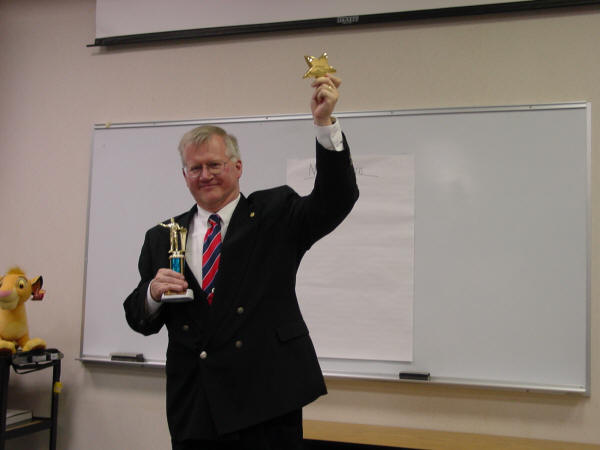
On December 1st I was scheduled to give a 5 minute presentation along with 18 other speakers. I had prepared my talk to include a humorous old joke that I had planned to tie into my opening.
As I was listening to the 10 speakers before me I noticed that 3 of them made references to their C & D grades in school(to great laughter). At least 2 of them talked about overcoming their earlier poor performances to achieve their college degrees. As I listened it dawned on me what a wonderful opportunity they had laid at my feet. I scrapped my opening and while standing in the wings waiting to be announced I came up with the following.
" Howdy --- While sitting in my seat listening to Kent, Tom and Randy give their presentations I notice them bragging about how bad their grades were in school and how hard they worked to overcome them. When I got out of the Army my college grade point average was 1.69 (laughter). I then made comments about the fact that once you earn 120 units you a qualified for a Bachelors of Science Degree. I graduated with 180 units (laughter). In fact I not only have a BS Degree I also have 2 Masters Degrees hanging on my will at home. And I did it the easy way, I married a woman who had 2 of them (lots of laughter).
The Definition of a Call back is: To paraphrase -
(Stand up Comedy the Bood - by Judy Carter
A call back can be a reference to any subject, emotion or phrase that previously got a laugh. The orginal joke must stand on it own.
(Step by Step to Standup comedy - by Greg Dean
A joke that refers back to another joke performed earlier in the day, often presented in a different context.
(Comedy Writing Secrets - by Mel Helitzer)
A call back is a reference to something said earlier in a routine or sketch. For a callback to work the time between the original and the callback to that event/joke/comment must be brief.
A call back should never be repeated more than 3 times in a presentation. The purpose is to help the audience feel part of a shared experience.
For speakers it could mean a reference back to an action/joke/comment or experience that the audience has shared with the speaker and presented in a humorous manner.


Toastmasters In Prison
Leadership skills taught to prison inmates
By Laurie Rathbun
2/9/2007 2:40:58 PMBob Freel of Menifee does volunteer work that few others are willing to do. One evening a week, he goes to the California Institute for Women near Corona and teaches leadership and communication skills to inmates who belong to a Toastmasters club in the prison. Freel, 64, is a Distinguished Toastmaster and started volunteering in 2003 when he became an area governor of six clubs in the Inland Empire. “It was a culture shock,” he said remembering his first visit to the prison. “I was one of those people who thought lock them up and throw away the key.” He views the inmates now as human beings that have made mistakes. “I think a lot of them have paid their debt and deserve a second chance,” he said. In fact, he has written to Governor Arnold Schwarzenegger to help parole some of the inmates.
Darrell Zeller, a former Toastmasters’ district governor in the Inland Empire, founded the club in 2002. Freel helps Zeller and another Toastmaster Randy Amelino run it. Freel said he’s known as the “Professor” because he teaches the inmates how to speak and build their confidence. The club meets on Thursday nights in two sessions and has more than 40 members. It costs the inmates about $65 to become members and most are determined to stay in it and complete the Toastmasters’ Competent Communication manual.
Freel said that 80 to 90 percent of them complete the manual and advance to another level. This past year, a club member became a Distinguished Toastmaster, which is the highest recognition attainable. She was the first incarcerated prisoner to do so. “We were all very proud of her,” Freel said. Most of the club’s inmates are serving life sentences. “I have worked with some women who have been very prominent in the newspapers in the last 40 years,” Freel said. He can’t disclose their names due to confidentially rules.
Freel has never felt that he was in physical danger from the inmates. He had to go through non-custodial training to volunteer and follows the same rules and regulations as the prison guards. He commented that it’s hard to get other Toastmasters to volunteer with the prisoners because they’re afraid, which he understands. “It’s a different environment,” he said. “You get tested. You have to earn their respect.”
Freel became involved with Toastmasters about 11 years ago when he took a Dale Carnegie management and leadership training course through his job. “I went through the course and part of every meeting you got up and gave a short talk for one to two minutes,” he said. He did well and wanted to improve his speaking skills so his instructor recommended that he join Toastmasters. He joined it in 1995 in Corona where he was living at the time.
Freel moved to Menifee in 2005 with his wife Gloria, 56. She’s the associate director of the Ontario City Library. He’s semi-retired and works one day a week for the United States Postal Service as a rural route carrier in Canyon Lake. Before that he was an operations support manager for 30 years at commercial and aerospace companies. Freel is a member of five Toastmasters clubs. He attends 10 to 12 meetings a month in Escondido, Temecula, Riverside and Woodbridge.
There are 10,500 clubs worldwide with 211,000 members. For more information about Toastmasters International, visit its Web site at www.toastmasters.org.
Comments or Questions about this piece?
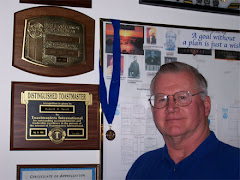
Photo: Laurie Rathbun photoMenifee resident Bob Freel is a Distinguished Toastmaster and teaches leadership and communication skills to inmates at the California Institute for Women near Corona.
All contents copyright The Valley News Inc.Arts ·
The Valley News Inc. 27464 Commerce Center Drive, Temecula, CA 92590
Wednesday, August 25, 2010
Toastmasters District Semi-Finals
On August 12, 2010 I watched 27 Speeches in the New Toastmasters Semi-Finals. These Semi's were created to Replace the former Regional Finals that were held in past years. After re-reading the notes I took during these semi-finals I have come to the following conclusions.
1. That the new Semi-Final process is not as effective as the
former Regional Structure.
2. What the former Regional process did was weed out those speakers
that won their District contests based on 1 speech.
3. In addition the former Regional process weeded out those
speakers that won their District not based on skills but more
on popularity. In this years semi-finals I walked away feeling
that the majority of the speeches I listened to were of the
advanced club level only.
4. I think that more speakers competing at the semi-final level
will need to avail themselves of coaching in order to compete
at the semi finals.
5. Of the 27 speeches I watched only 4 were of the championship
level needed to compete at the International
Judging level.
6. Each year many competitiors and audience members walk away from
a contest not understanding what happened? Why did the judges
choose one contestant over another. Many highly skilled and
excellent speakers fall by the wayside due to poorly skilled
or biased judging. Will it ever be fair? Probibly not.
I will say this. This years winner deserved to win. He was far above those who competed against him.
Subscribe to:
Posts (Atom)